📊 One Source of Truth for Patient Feedback
See what patients publicly say about your hospitals, clinics, and labs — and how each location compares to competitors — in a single operational view.

Stop guessing what impacts patient trust and perception. Yellow Tokens centralizes spontaneous, public patient feedback from Google Maps and major social platforms — and turns it into clear, prioritized action plans that improve experience, reputation, and confidence.

See what patients publicly say about your hospitals, clinics, and labs — and how each location compares to competitors — in a single operational view.
Yellow Tokens converts recurring praise and complaints into AI-driven PDCA action plans, helping teams focus on what truly impacts patient perception.
Track spontaneous CSAT and NPS (derived from unsolicited public feedback) by location, identify trust drivers, and prioritize actions that reduce reputational and experience risk.
Compare patient experience drivers, complaints, and perceptions across hospitals, clinics, and laboratories — far beyond star ratings or sentiment charts.
Yellow Tokens does not stop at analysis. Every insight becomes a structured PDCA action plan with clear priorities and accountability.
Capture real, unsolicited patient feedback from public platforms — no surveys, no forms, no disruption to care routines.

Yellow Tokens is built on over 20 years of experience designing customer insight systems for complex, multi-location operations — now delivered through a focused SaaS platform.




Understand how patients perceive scheduling, wait times, staff interaction, and communication clarity. Benchmark against nearby clinics and prioritize improvements that build trust and return visits.
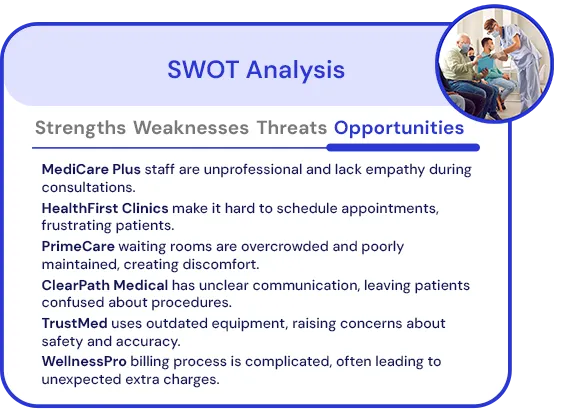
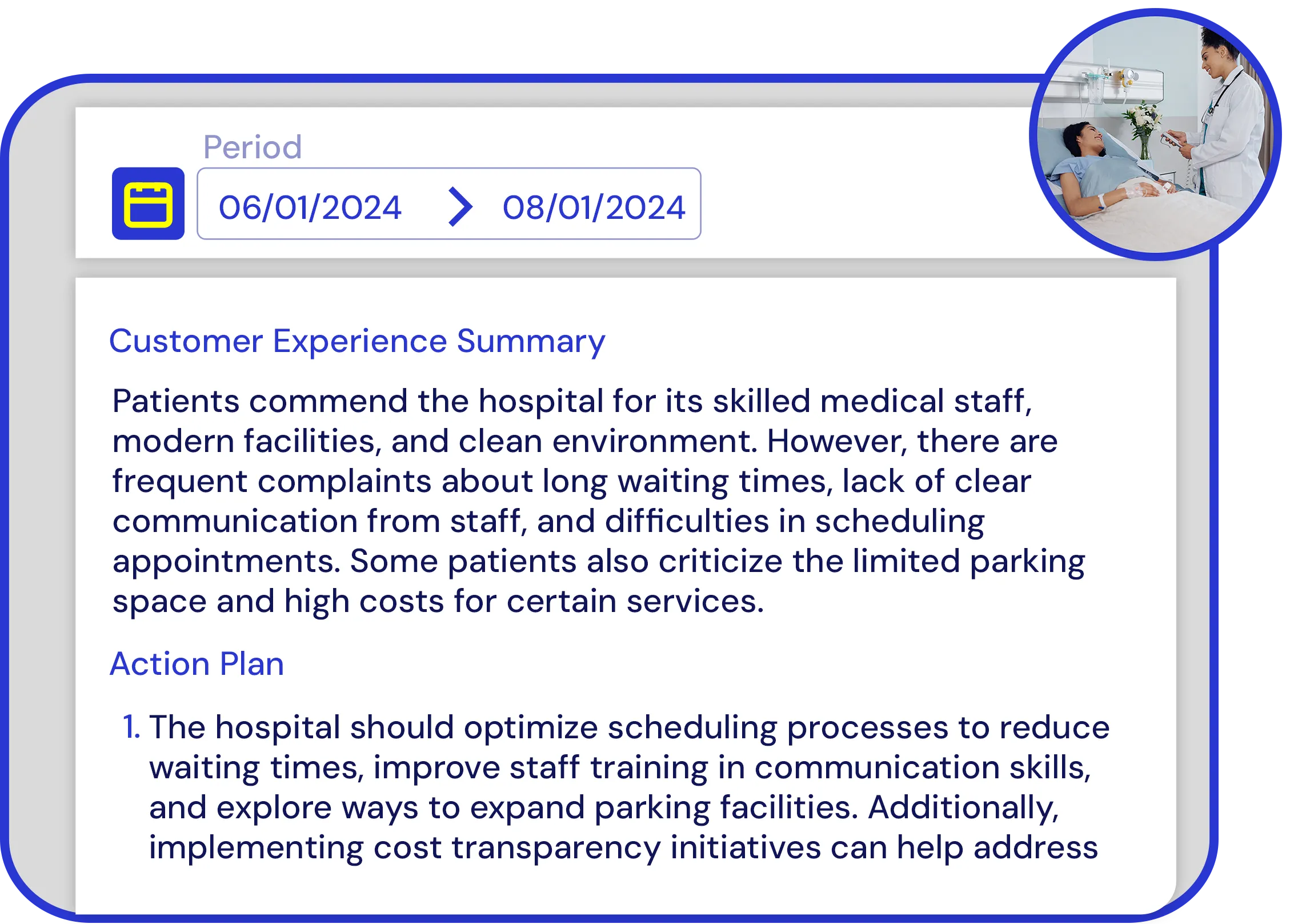
Analyze how patients publicly perceive care quality, staff empathy, communication, and facility conditions. Convert recurring feedback into structured PDCA action plans that reduce reputational risk and improve experience.
Capture spontaneous patient feedback related to turnaround time, result communication, and staff interaction. Identify recurring friction points and prioritize improvements that reinforce confidence and satisfaction.
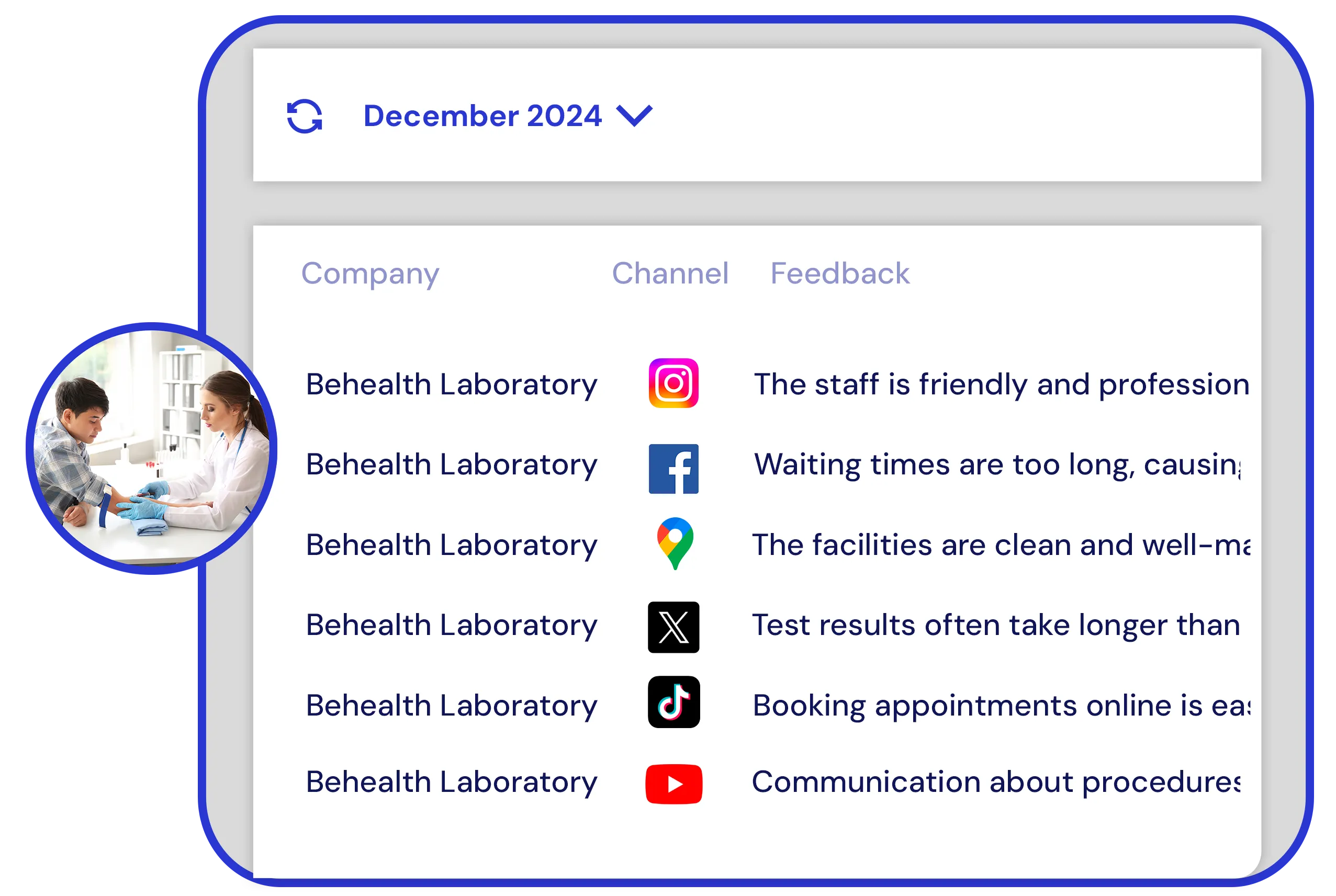
Yellow Tokens analyzes real, public, and unsolicited customer feedback from the digital platforms where consumers naturally share their experiences. These spontaneous signals are transformed into structured intelligence and concrete Action Plans — going far beyond mentions, keywords, or engagement tracking.
Brand-level feedback shared openly across social and content platforms, reflecting perceptions of reputation, messaging, and customer experience.


Location-based feedback tied to physical experiences, service quality, and operational execution at individual stores, branches, or venues.

Yellow Tokens uses a flexible, usage-based model — pay only for the companies, establishments, and products you analyze, and for the users in your workspace.
Prefer full details? Visit the Pricing page.
A structured workflow to identify patient experience gaps, prioritize improvements, and reduce reputational risk.
Create a free account and upgrade to a business subscription to access full healthcare intelligence and action planning.
Start NowAdd hospitals, clinics, or labs by linking official social profiles, register physical units, and include competing providers to enable comparative analysis.
Yellow Tokens structures public patient feedback into themes related to communication, wait times, and staff interaction.
Analyze spontaneous CSAT and NPS by unit and channel to identify high-impact issues requiring immediate action.
Continuous Improvement PDCA Action Plans focus on improving patient experience and operational consistency internally. When competing providers are also registered, Competitor Gaps Action Plans highlight perception gaps that help attract patients dissatisfied with alternative providers.
Explore real-world examples of how organizations use spontaneous customer feedback to identify opportunities, improve operations, and make better decisions.
How Yellow Tokens helped a CX manager optimize the feedback analysis process, improving efficiency and focus on improvement actions.
View case study →How a pharmacy chain used Yellow Tokens to stand out in a saturated market, offering unique experiences to customers and increasing its market share.
View case study →No. Yellow Tokens does not focus on tracking mentions or volume of comments. The platform is built on Spontaneous Feedback Intelligence, which structures public, real, and unsolicited patient feedback into recurring themes, signals, and priorities designed to support decision-making — not monitoring. Learn more: Yellow Tokens vs Social Listening Tools.
Manually checking reviews shows isolated opinions. Yellow Tokens aggregates feedback at scale, connects comments to themes, recurrence, and impact, and contextualizes them with reputation, benchmarking, and structured action planning through Online Review Intelligence and Reputation Intelligence.
Individual comments can be emotional, but Yellow Tokens does not act on isolated feedback. The platform prioritizes patterns that repeat consistently across time, locations, and sources, filtering out noise and focusing on structurally relevant signals.
No. Yellow Tokens works exclusively with publicly available content. It does not access private systems, medical records, or protected health information, and does not require authentication from third-party platforms. Analysis focuses on aggregated experience signals, not individual cases.
No. Yellow Tokens does not ingest sensitive personal data, protected health information, or clinical records. The platform analyzes only publicly available feedback voluntarily shared by patients on open platforms, processed in aggregated and anonymized form.
Yellow Tokens does not evaluate clinical quality or medical decisions. It supports quality improvement by identifying recurrent friction points that affect perceived trust, communication, access, and operational reliability — factors that directly influence patient confidence and outcomes.
No. Yellow Tokens complements existing quality and experience programs. While surveys capture solicited feedback, Yellow Tokens adds a continuous, unsolicited perspective through Customer Experience Intelligence, revealing issues that surveys and formal channels may miss.
Prioritization is based on recurrence, severity signals, and comparative benchmarks. Only themes that persist over time and impact perception at scale are elevated, reducing noise and supporting focused decision-making.
Decisions always remain under the organization’s governance. Yellow Tokens structures insights and suggests improvement directions, but validation, approval, and ownership are defined internally by leadership.
No. Yellow Tokens supports decisions — it does not replace them. Through PDCA Action Plans, the platform organizes improvement opportunities, but execution choices, responsibilities, and priorities are assigned by the organization.
The platform is designed to reduce interpretive and analytical workload. Insights are summarized through AI Insights and structured dashboards, avoiding manual classification or spreadsheet-based analysis.
Recurring feedback signals are translated into structured improvement cycles using Continuous Improvement PDCA Action Plans, allowing teams to track priorities, progress, and outcomes over time.
No. Yellow Tokens is used by hospitals, clinics, and laboratories of different sizes. The platform scales based on the volume of feedback, number of locations, and benchmarking needs, without requiring dedicated analytics teams.
Yellow Tokens emphasizes trend analysis. Only patterns that repeat across sources and timeframes are elevated, helping leadership focus on structural issues rather than one-off events.
Yes. By consistently identifying and addressing experience gaps, organizations can improve perceived reliability, communication, and consistency — key drivers of patient trust. Progress can be tracked using Spontaneous CSAT, Spontaneous NPS and the Spontaneous Feedback Index (SFI).